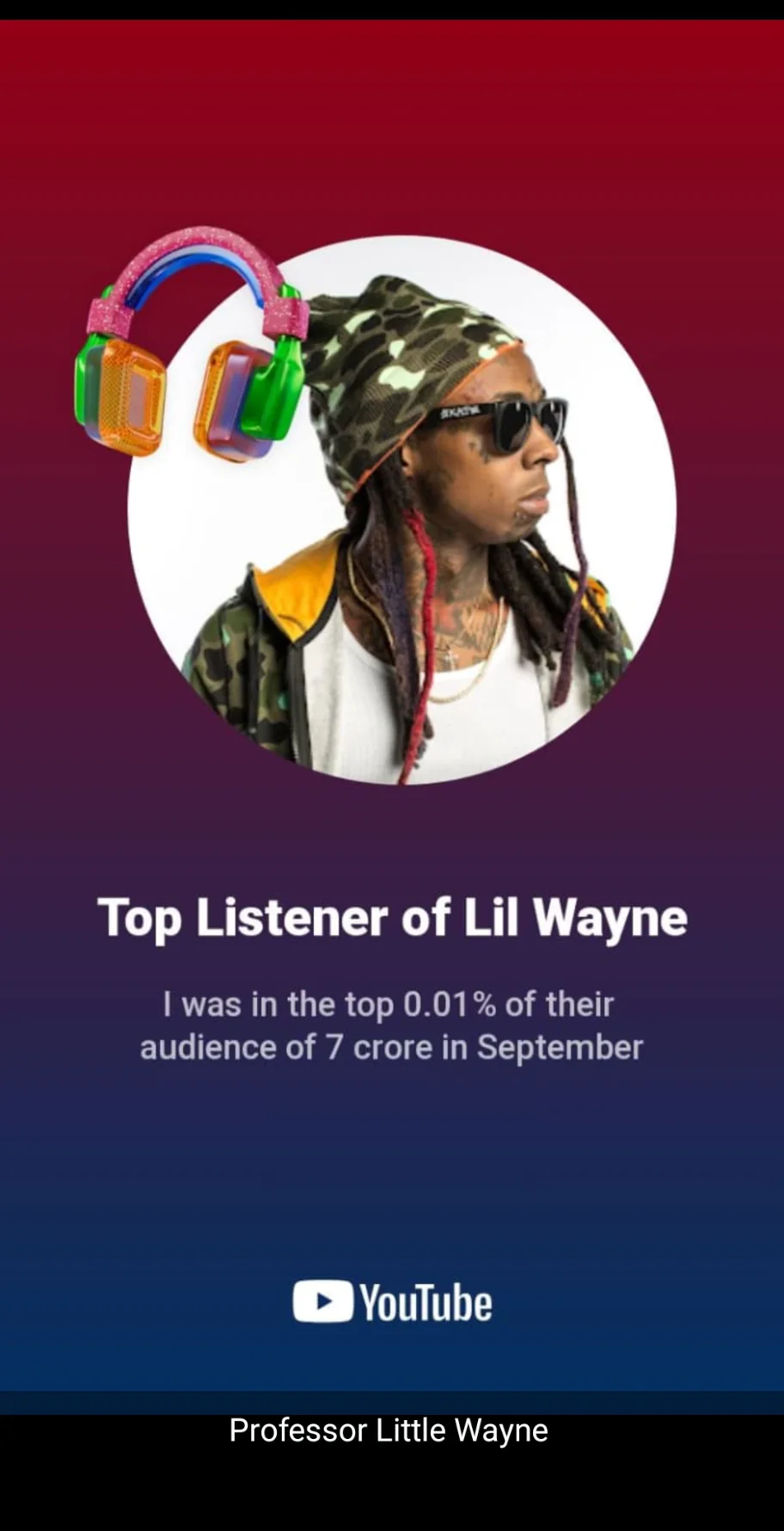
One listener went way too deep into Lil Wayne. Instead of staging an intervention, we built a school for flow, wordplay, creative courage and the mysterious joy of pressing replay.
No degree. No celebrity endorsement. Absolutely too many metaphors.
WAYNEOLOGY33⅓STUDY SIDE A
PROFESSOR LITTLE WAYNE ☺
THIS IS A LOVE LETTER! ★
✦
✳
SCROLL TO ENROLL ↓COURSE CODE: WZY–001MADE WITH RESPECT, NOT AFFILIATION
RHYTHM IS THINKING IN TIME ✳ LISTEN CLOSER ✳ WORDS CAN BEND ✳ MAKE SOMETHING ORIGINAL ✳ RHYTHM IS THINKING IN TIME ✳ LISTEN CLOSER ✳ WORDS CAN BEND ✳ MAKE SOMETHING ORIGINAL ✳
01 / THE ORIGIN STORY
EXHIBIT A — A VERY SPECIFIC OBSESSION
THE RECEIPT.
Some people collect stamps. Some collect rare coins. Apparently, someone here collected an unreasonable number of Lil Wayne listening minutes.
0.01%
“Top listener” percentile shown on the user-provided YouTube recap for September.
The card also displays an audience of 7 crore (70 million). These are the numbers shown in a personal listening screenshot—not a public, independently audited leaderboard. They say something about repeat listening, not about musical expertise or superiority.
✳
Our thesis: A repeated listen can be more than a habit. It can become a doorway into language, attention, memory, play and belonging. That's an invitation to investigate, not a claim that every replay improves cognition.
Source: user-provided YouTube recap image. The cropped display preserves the card; the original is linked at left. Not separately verified by this site.
02 / THE UNOFFICIAL MANIFESTO
A CLASSROOM WITHOUT A CLASSROOM
DON'T JUST CONSUME THE ART. NOTICE IT.
When a rapper stretches a syllable across a beat, flips a familiar object into an unexpected image, or lands a rhyme where your ear didn't expect it, you can hear technique—not just charisma.
That's the point of Wayneology: celebrate the artist, then zoom out to the craft. No reproductions of copyrighted lyrics. No pretending that fandom equals scholarship. Just close listening, original experiments and open references.
HIP-HOP IS WORTH STUDYING. ↗
03 / YOUR SIX VERY UNOFFICIAL CLASSES
THE SYLLABUS
SIX WAYS TO LISTEN.
Each class connects a piece of rap craft to something bigger. These are interpretations and listening prompts, not certified lessons from the artist.
01 / LANGUAGE↗
✳
METAPHOR GYMNASIUM
A punchline works when two distant ideas suddenly share a room. Metaphor is not just decoration; it changes what we notice.
TRY THE EXPERIMENT +
Describe a boring object as if it were a planet, a courtroom or a family member. Which properties transfer? Which ones don't?
02 / RHYTHM↗
♫
THE ART OF FLOW
Rap flow involves how syllables, accents and rhyme positions interact with the beat. Timing itself becomes expressive.
TRY THE EXPERIMENT +
Tap four steady beats. Speak the same simple sentence first on the beat, then a little ahead of it. Hear the difference.
03 / CREATIVITY↗
↝
THE MIXTAPE MINDSET
Rap mixtape culture invites a useful creative question: what can you make by working with, transforming or responding to existing forms?
TRY THE EXPERIMENT +
Take a familiar format—a recipe, a news report, a product manual—and write an entirely original paragraph in that shape. Credit what inspired it.
04 / PSYCHOLOGY↗
◉
REPLAY & RESONANCE
People use music for pleasure, memory and emotional context. The same song can mean different things at different moments.
TRY THE EXPERIMENT +
After one listen, note what you felt before and after. Don't assume the music caused any change; notice the context too.
05 / PHONETICS↗
≈
WORDS AS INSTRUMENTS
Rhyme can depend on vowels, consonants, stresses and performance—not merely the last letters on a page.
TRY THE EXPERIMENT +
Say “motion / ocean” aloud. Now make a two-word phrase that rhymes with “ocean.” Listen rather than just looking at spelling.
06 / AGENCY↗
★
MAKE YOUR OWN NOISE
Admiration becomes especially interesting when it leads somewhere: your own essay, drawing, verse, question, website or experiment.
TRY THE EXPERIMENT +
Create eight completely original lines on something ordinary: a bus stop, rain, a cup of tea. Let the subject be yours.
THE RECORD-SHELF EXERCISE
FOUR STOPS. FOUR QUESTIONS.
Rather than ranking albums or claiming a definitive "best" era, compare different moments in the official discography. Listen on the artist’s licensed platforms, then answer one question from each stop.
1999THA BLOCK IS HOTListen for the young artist's cadence. What patterns do you recognize?
2005THA CARTER IIWhat sounds different in breath, pacing, enunciation or production?
2008THA CARTER IIIPick one track. Where does the vocal rhythm agree with the beat—and where does it resist?
2018THA CARTER VCompare a verse with the first stop. What changed? What persisted?
04 / THE RHYTHM EXPERIMENT
NO SAMPLES • NO COPYRIGHTED AUDIO
BUILD A BEAT FEEL.
Rap isn't only words. It's the relationship between words and time. Try an original, synthesized practice pulse, then count how differently your brain wants to place syllables.
WAYNEOLOGY RHYTHM MACHINE● IDLE
Tap START. Count: ONE • TWO • THREE • FOUR.
Audio starts only after you press the button. It is generated in your browser, not streamed or recorded. Headphone volume: start low.
LESSON A
BEAT ≠ FLOW
The pulse is a reference. A rapper can place syllables around it—on the beat, before it, after it, or across it. Our clicks are a simplified listening aid, not a reconstruction of any Wayne recording.
LESSON B
FEEL THE SHIFT
Try the same eight spoken syllables against each pattern. Notice which words you stress. Kyle Adams's analysis of rap flow offers a deeper music-theory account.
Observed: the submitted listening card says top 0.01%. Documented: these cited scholars study rhythm, rhyme or music and flow. Interpretation: this fan's repeated listening inspired an interest in craft. Those are three different kinds of statements.
07 / GIVE THE ARTIST HIS STREAMS
GO TO THE ACTUAL MUSIC.
We don't host commercial songs, upload lyrics or imply artist approval. The songs belong where the artists and rights holders publish them.
A listening habit became the starting point for bigger questions: why does language feel so alive in certain verses, how can rhythm surprise us, and what might this inspire us to create for ourselves?